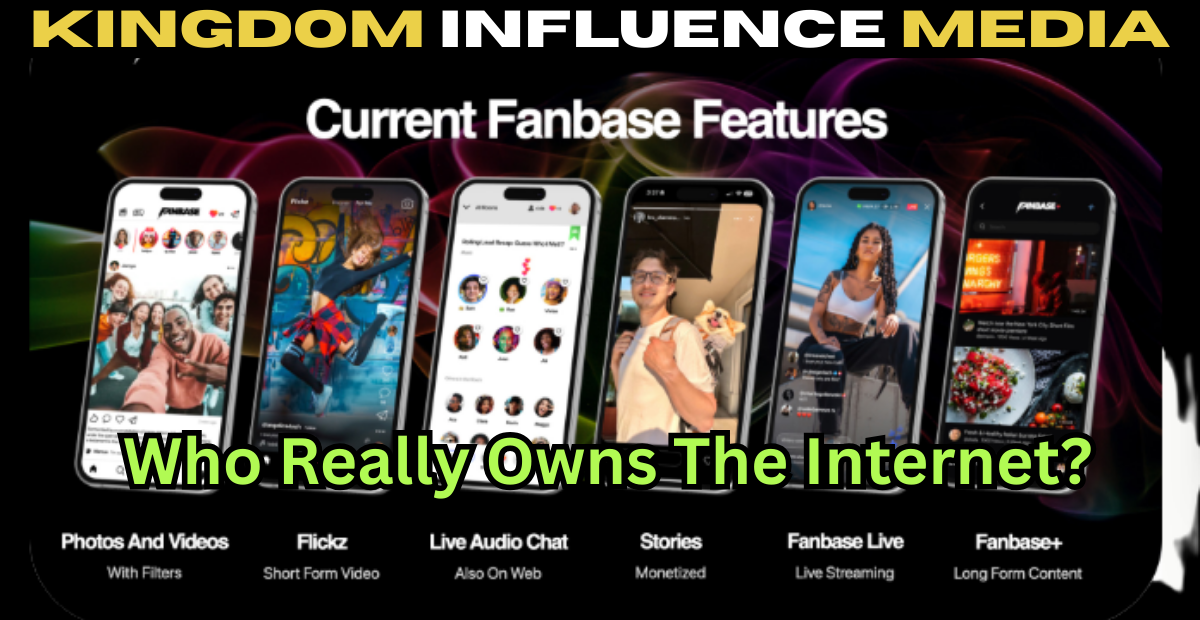
When we talk about platforms like Fanbase, the idea sounds promising: a space where creators can get paid fairly, where censorship is supposedly minimized, and where you finally feel like your hard work is respected.


It feels like a step forward for independent voices who have been silenced, shadow-banned, or demonetized on the bigger platforms. But here’s the real question: how long will it last?
Because when you strip away the excitement, you have to face a truth many people don’t talk about—no matter what app we create, somebody still owns the medium.
The Illusion of Freedom Online
At first glance, Fanbase and other alternatives offer something refreshing: independence. But even independence online comes with invisible strings. To run an app, you rely on internet infrastructure—servers, hosting providers, app stores, and cloud services. These are controlled by massive corporations like Amazon Web Services (AWS), Google Cloud, Apple, and Microsoft. If one of them decides you’ve violated their terms, your entire platform can disappear overnight.
Think about it: apps don’t run in a vacuum. They live on hardware, cables, satellites, and servers that are ultimately under the control of a handful of tech giants and governments. Even if Fanbase builds a community free from censorship, the moment it clashes with bigger powers—say, the app store policies or federal regulations—it’s back to the same system we thought we escaped.
Who Really Owns the Internet?
It’s easy to assume “no one owns the internet,” because it feels like an open web. But here’s the logical point people forget:
- The physical infrastructure of the internet (fiber optic cables, undersea lines, data centers) is controlled by telecom companies and governments.
- The gateways to access it—like app stores, search engines, and browsers—are owned by a small number of corporations.
- The rules of engagement (laws, censorship policies, trade agreements) are written and enforced by powerful political bodies.
So while the internet as an idea is free, in reality, it’s filtered through layers of control. The person with the app may feel empowered, but the person with the server has the real authority.
What Does That Mean for Fanbase?
For now, Fanbase has carved out a valuable niche: creators can earn, speak, and connect with less fear of censorship. But if history shows us anything, it’s this—platforms grow, and when they grow, they attract regulation and pressure. Look at YouTube. Once, it was a wild west of free voices. Now, it’s one of the most heavily monitored and monetized platforms on earth.
Fanbase may not face that level yet, but the infrastructure it depends on is not immune to the bigger powers. That’s the paradox: even platforms that promise freedom are chained to the same system they’re trying to escape.
Can the Internet Ever Be Defeated?
In truth, the internet isn’t something we can “defeat.” It’s a medium, like airwaves or electricity. Whoever owns the pipelines, owns the control. And for us as users and creators, the best we can do is stay aware, adapt, and diversify.
Fanbase is a step in the right direction—it gives us hope that creators can have more autonomy. But it doesn’t change the fact that the internet is ultimately controlled by forces bigger than us. That’s not a conspiracy; that’s reality.
And maybe that’s the real conversation: are we ready to admit that true freedom online is only as real as the people who own the cables, the clouds, and the code?